


Not long after I had joined forces with Judith Howard and established the firm of "Page and Howard" with a workshop under a railway arch in Brixton, London, we had an enquiry about building a new fair organ. I asked what sort of size was wanted, so the man took me outside and pointed to a van standing in the yard. He said "Something that would go into that van."
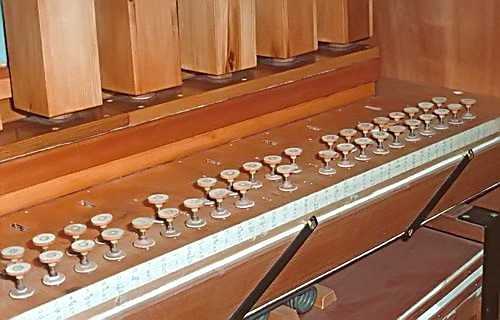
Working between our overhaul jobs the project gradually evolved. Judith suggested getting someone she knew in the Netherlands to make the pipes, as neither of us had made flue pipes before, although I had had some experience with reeds. She got in touch with him, and a deal was struck for all the flue pipes we needed except for the largest basses. Those would be made by modifying old church organ pipes we happened to have in storage - old seasoned timber is far better for working with for organ action and parts.
By the spring of 1985 the 48-key organ, job number 48 (pure coincidence) was taking shape. We decided to use the Gavioli scale as there would be a plentiful supply of music for it. We had just completed the restoration of a 46-key Marenghi for John Forrest, so our organ would have a similar pipe specification, but our larger organ would also have a trombone. The 46-key scale didn't have registers, so we opted for the 48-key, with the trombone in the bass and trumpet on melody being brought into play with the forte register. The construction was based around a main bar chest with Gavioli-style push-rod action (see picture above). The trumpet and trombone were operated via a combined membrane action running across the width of the case, mounted horizontally to save height. The picture just shows some of the trombones sitting on top of that. There are 144 pipes in all, please see specification.
The wind supply was by blower into a single reservoir through a butterfly control valve operated by cord and pulleys from the reservoir top, church organ style. We managed to obtain a second-hand blower, and we had the big long-arm torsion springs made for us by a company in Leeds, recommended by Mike Dean of Dean Organs - thanks Mike.
  |
Above right: The accompaniments (one side) installed into the organ, clearly showing the two different style ranks. The cellos were made with "dead-length" tuning, as most Dutch pipes are made. The tuning is far more stable than pipes with movable tuning slides, but more tricky to get right in the first place. I know what an organ owner would prefer!
  |
Above left: The trombone pipes laid out on the ground to show where they were mitred. One cut at (just a little) more than 45 degrees (the pipes are tapered and I wanted the top face of the upper pieces to be level with the case top) and the top section twisted 180 degrees makes the perfect mitre. Mitring pipes in this way doesn't affect speech. (Narrow scale pipes such as violins need two 22½° mitres for one right-angle turn.) Above right: The trombones now fitted into the case.
The façade was modelled after an illustration of a 50-key organ in a facsimile Gavioli catalogue. It was made entirely by myself and decorated by Judith Howard. The organ's first few appearances were without side cases. The drums were mounted on each side on shelves, similar to some small Limonaires, but eventually two side cases were made for it. The organ then appeared as shown in the picture below.
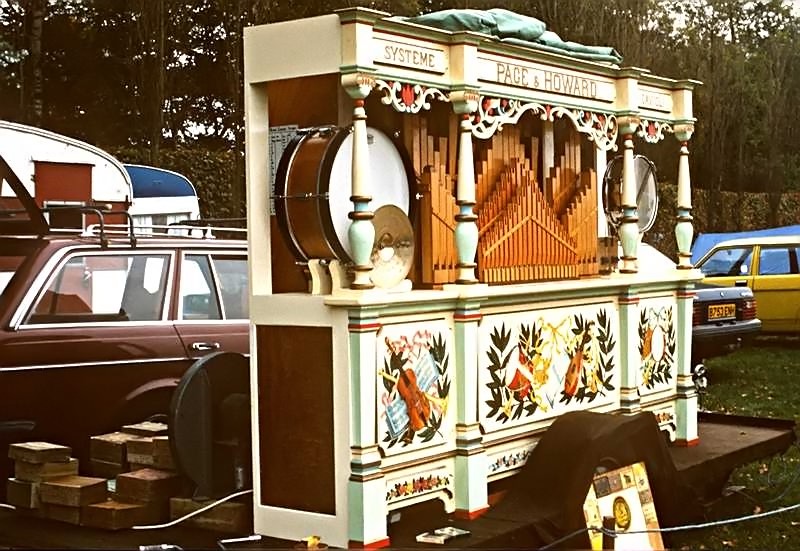
During the building work, we tried contacting the man who enquired in the first place, but to this day we have never heard from him, even after 18 months of publicity and touring around the country, from Manchester to Devon. Our eventual buyer was an enthusiast who toured it for about a year before it was sold to another enthusiast, in Manchester. Eventually it was acquired by an Essex showman who was looking for an organ to take with him to Tasmania, where he set up a small fair, and presented the organ with his gallopers.

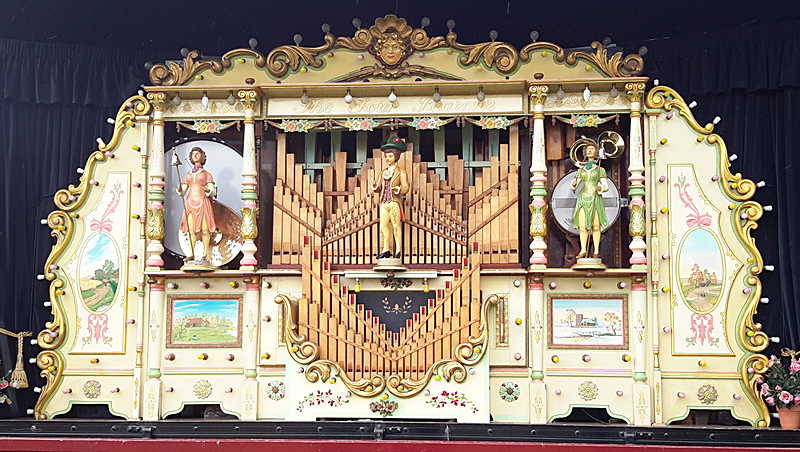
My second large 48-key organ was built to the order of the late Chris Edmonds. Internally it was identical to The Princess, but delivered without a façade. Chris pulled out all the stops to make this organ into a first class presentation - no expense spared. Naming it "The Four Seasons", he commissioned some great music, and presented the organ at many rallies.
  |
Above left: I set the trumpet on my voicing machine, which was only suitable for church organ ranks. For fair organ pipes I placed a spare Mortier unit chest on top of the machine and tubed up to the wind supply. Using the Mortier push-rods I was able to test the pipes' speech and tuning. Note the trebles with harmonic resonators. Above right: the trumpet pipes in position in the organ. Just in front of it is the "tent-shaped" block. This is for the violin, which stands in front of the 16-foot cello. The longest pipes of the violin needed to be raised to make the three-rank melody set look right.
  |
© 2018, John Page